
Higher prices for essential commodities following the truckers' strike pushed up inflation by 0.16 per cent to a four-year high of 8.33 per cent for the week ended August 28.
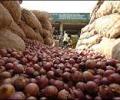
According to the official data, arrival of onion in wholesale mandi has increased almost three times to 30,000 tonnes in Bengaluru and 10,000 tonnes in Hyderabad, respectively, in the last one month.
Inflation moved up to 7.23 per cent in April on account of spurt in prices of vegetables, meat, milk and pulses, although onion and fruits showed a declining trend.
Overall food inflation rose to 10.74 per cent in May, from 10.49 per cent in the previous month. Food articles have 14.3 per cent share in the WPI basket.
Industry experts insist that rising steel prices are triggered by rising input cost like scrap, iron ore and coking coal. The current international pricing scenario demands a prices increase domestically. The rising raw material costs and other available inputs as well as limited capex resources have driven the steel prices. The government has been taking steps to control prices by increasing the export duties on some commodities and even banning exports on some.
Costlier fuel products and manufactured items including edible oils pushed up inflation to 4.95 per cent during the week ended February 26.
Inflation at 6 per cent was a matter of concern in the evolving macro-economic outlook and the Reserve Bank of India fears that consumer prices could be even higher at 7 to 8 per cent.
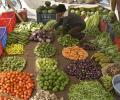
In most cases, however, retail consumers are paying higher prices in the absence of direct procurement from aggregator or farmers.

Factory output, measured in terms of Index of Industrial Production, showed an improvement mainly because of an uptick in mining and manufacturing production and larger offtake of capital goods.

In the coming weeks prices are expected to further cool down as new crop from Karnataka has started coming into the market.

The wholesale price-based inflation rose to an eight-month high of 1.48 per cent in October, as manufactured products turned costlier. The WPI inflation was 1.32 per cent in September and zero per cent in October last year. This is the highest level of wholesale price index-based (WPI) inflation since February when it was 2.26 per cent.

Costlier food items, including vegetables, pushed the October wholesale inflation to 7 per cent, the highest in the current financial year.

These 10 stocks represent the best mix of value and growth, offering relatively low price-to-earnings and price-to-book ratios, a high return on equity, and sufficiently high potential from current levels.

Wholesale price inflation stood at 4.78 per cent in November. The consumer price index for agricultural labourer and rural labourers were 13.73 per cent and 13.51 per cent in October.

'Commerce Minister Piyush Goyal once told me that if onion prices rise we will face the flak for it across India.' 'What can farmers expect from a government which talks like a trader and only believes in (electoral) profit and loss?'

Last date for submitting the offer is August 27.

'In addition, we have geopolitics and politics and all the other things that will affect commodity prices.'
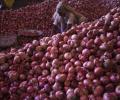
Retail inflation, based on Consumer Price Index, hit a 15-month high of 4.88 per cent in November

The wholesale price-based inflation shot up to an all-time high of 10.49 per cent in April, on rising prices of crude oil and manufactured items. Also, a low base of April last year contributed to the spike in inflation in April 2021. The WPI inflation was 7.39 per cent in March 2021, and (-) 1.57 per cent in April 2020. This is the fourth straight month of uptick seen in the wholesale price index (WPI)-based inflation.
Inflation shot up to a four-year high at 8.17 per cent for the week ended August 21 despite a number of steps, including duty cuts on petroleum products and steel, taken by the government to rein in prices.

Food prices, which have contributed to a large part of inflation over recent years, have remained benign, despite unseasonal rain.

Vegetables and fruits have weights of 1.74 per cent and 2.11 per cent, respectively, in the wholesale price index.
Households continued to bear the brunt of increased cost of living with inflation rising by 0.35 per cent to 7.96 per cent for week ended August 7, mainly due to costlier vegetables, petrol, diesel and aviation turbine fuel.

Parts of Uttar Pradesh, Haryana, and Punjab have also been impacted.

RBI in its policy review last month kept interest rates unchanged and said it sees an upside risk to inflation.
Onion prices, however, continued to rule high with 79.78 per cent increase in September.

Prices of the kitchen staple in Azadpur mandi, Asia's largest wholesale market, were ruling at Rs 60 per kg today as supplies were below normal.

Bhujbal stridently opposed Maratha quota activist Manoj Jarange's demand for Maratha quota from the Other Backward Classes (OBCs) share.
The wholesale price index's annual rise compared with a 7 per cent jump forecast by economists in a Reuters poll.

'Her story, her life, her aspirations and struggles...' 'Indian weddings are not just about fuschia, pink and dancing. They have many nuances.'
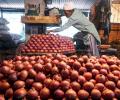
The ban on export of onion will continue till its previously announced deadline of March 31 as the government is keen to keep prices under check and ensure domestic availability, a top official said on Tuesday. On December 8, 2023, the government had banned export of onion till March 31. "Ban on onion exports has not been lifted. It is in force and there is no change in the status," consumer affairs secretary Rohit Kumar Singh told PTI.
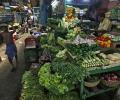
Inflation has reappeared as a global issue in both advanced and emerging economies and India needs to be wary of "imported inflation", especially due to high oil prices, according to the Economic Survey 2021-22 released on Monday. "Inflation has reappeared as a global issue in both advanced and emerging economies. "India's Consumer Price Index inflation stood at 5.6 per cent YoY in December 2021 which is within the targeted tolerance band," the survey report presented in the Parliament by Finance Minister Nirmala Sitharaman noted.

As there is a moderation in car sales, dealer stock levels across the entire industry have surged to alarming heights. However, the situation is under control at HMIL.

At present, the US-based retail giant operates B2B e-commerce platform in four cities -- Lucknow, Hyderabad, Guntur and Vijayawada -- in the country.

Retail inflation rose marginally to 9.84 per cent in September, mainly due to a hike in food prices, particularly of vegetables.

India on Tuesday set a minimum export price for onions of $300 per tonne to discourage overseas shipments amid an inflation scare that threatens to stoke public anger over rising prices at local food markets.

The excise duty cut will translate into a reduction of Rs 9.5 a litre on petrol and Rs 7 a litre in diesel after taking into account its impact on other levies.

In the retail markets, rates have fallen to Rs 30-35 a kg from Rs 100-level.

Benchmark indices Sensex and Nifty gained around half a per cent to close at nearly five-month high levels on Monday following continuous foreign fund inflows and firm trends in Asian and European markets. Rising for a second straight day, the 30-share BSE Sensex climbed 317.81 points or 0.51 per cent to settle at 62,345.71, the highest closing level since December 14. During the day, it rallied 534.77 points or 0.86 per cent to 62,562.67.
 © 2026 Rediff.com - Advertise with us - Disclaimer - Privacy Policy - Sitemap - Feedback - About us - Terms of use - Grievances